
August 24, 2013
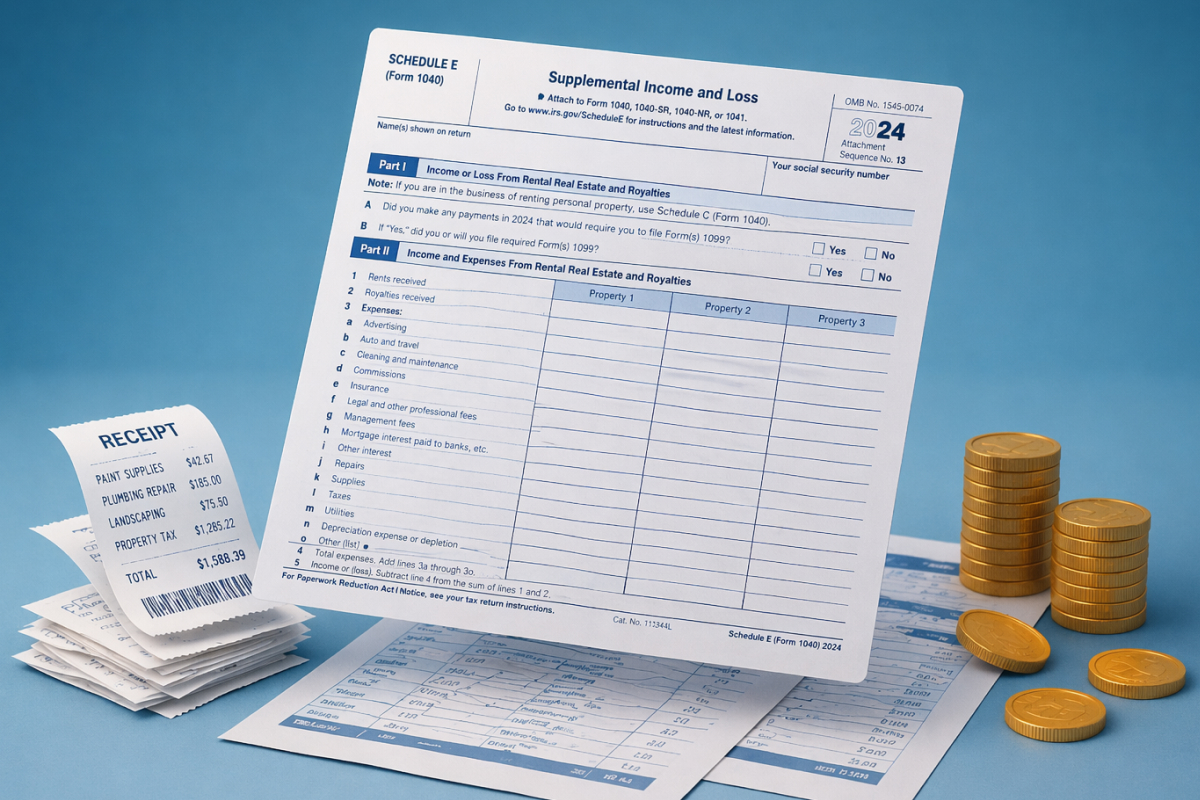
There is a version of real estate investing where your properties not only generate cash flow — they generate losses on paper that wipe out your other income and reduce your tax bill to near zero. This isn't a loophole. It's exactly what the tax code was designed to allow for investors who manage real estate as primary occupation, not a side hustle.
But most real estate investors never access these benefits fully, because they don't understand the rules that govern when rental losses are usable and when they're not. Those rules hinge on one central concept: the distinction between active and passive income and losses.
This article explains how that distinction works, who qualifies to use rental losses against ordinary income, and the specific strategies that let active investors turn depreciation and paper losses into real tax savings.
To understand how to unlock rental losses, you first need to understand why they're locked in the first place.
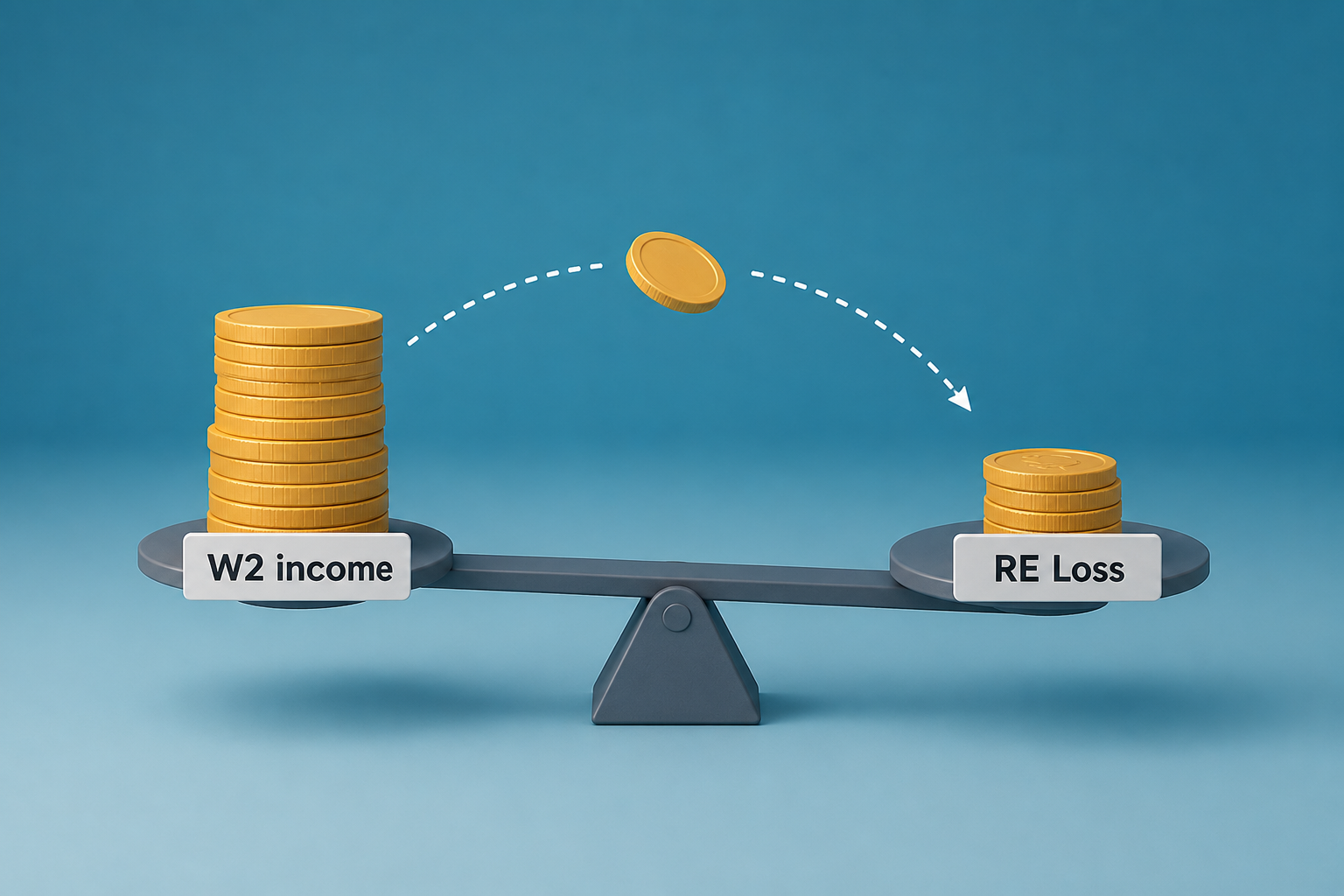
Under IRC Section 469, rental activities are automatically classified as passive activities for tax purposes — regardless of how involved you are in managing them. Passive activity losses can only offset passive activity income. If you have no other passive income, your rental losses are "suspended" and carried forward to future years, where they wait until you either generate passive income or sell the property.
For a W-2 employee with three rental properties, this is the default reality: those properties have the potential to show significant losses on paper (thanks to certain tax strategies listed below), but those losses can't offset the salary income. They sit in suspended animation on Form 8582 until they're eventually released.
There are two exceptions that change this picture entirely. Understanding them — and knowing which one applies to your situation — is the key to active real estate tax strategy.
The first exception is available to almost anyone who owns rental property and is worth knowing even if it's not the most powerful strategy.
Under IRC Section 469(i), if you actively participate in a rental activity, you can deduct up to $25,000 in rental losses against ordinary income — even though the activity is technically passive. "Active participation" here is a low bar: it means you make management decisions (approving tenants, deciding on rents, authorizing repairs), even if a property manager handles day-to-day operations.
The catch is an income phase-out. The $25,000 allowance begins to phase out at $100,000 in Adjusted Gross Income (AGI) and disappears entirely at $150,000. For investors with W-2 income above $150,000, this exception provides no benefit at all.
This is why high-income investors focus on the second, more powerful exception: real estate professional status.
How do you qualify as an active real estate professional?
Real estate professional status (REPS) under IRC Section 469(c)(7) allows qualifying investors to reclassify all rental activities from passive to active (non-passive). Once your rental losses are non-passive, they can offset any income: W-2 wages, business income, capital gains, anything. There is no dollar cap.
This is the exception that lets a real estate investor (or their spouse) bring a tax return to zero or below.
To qualify as a real estate professional, you must meet both of the following requirements in a given tax year:
1. More than 750 hours spent in real property trades or businesses in which you materially participate.
2. More than 50% of your total personal services for the year must be in real property trades or businesses in which you materially participate.
The second test is what makes this genuinely difficult for someone who holds a full-time W-2 job. If you work 2,000 hours per year at your employer, you'd need to spend more than 2,000 hours in real estate to satisfy the 50% test — a near-impossible bar while employed full time. This is why REPS is most commonly used by:
Here's a planning opportunity that many investors overlook: only one spouse needs to qualify. If one spouse qualifies as a real estate professional and the couple files jointly, all rental losses become non-passive on the joint return — offsetting the other spouse's W-2 income, business income, or any other taxable income.
This is a legitimate and powerful planning strategy. A high-earning W-2 spouse can significantly reduce the household's tax bill if the non-working (or part-time working) spouse qualifies as a real estate professional by managing the portfolio's properties and documenting their time carefully.
The qualifying spouse must still meet both tests independently — the hours and percentage tests apply to that spouse's individual time, not combined household hours.
The 750 hours can come from any real property trade or business, including:
Importantly, time spent as an investor (reviewing financial statements, monitoring accounts, attending investment meetings) does not count toward the 750-hour test unless you're also involved in operations.
Keep a contemporaneous log of your hours. "Contemporaneous" means recorded at or near the time the work is done — not reconstructed at year-end. Courts and auditors have repeatedly rejected retroactively constructed logs. The IRS knows what a fabricated time log looks like. Use a calendar, a time-tracking app, or even a simple daily note — but record it as you go.
See IRS Publication 925 and the Form 8582 instructions for the full rules.
For investors who can't qualify as real estate professionals there's a separate, increasingly popular path: short-term rentals (STRs).
Under the passive activity regulations, rental activities with an average rental period of 7 days or less are not treated as rental activities at all for passive activity purposes. Instead, they're treated as an active trade or business. This means:
This is the mechanism behind the Airbnb tax strategy that became widely discussed in the early 2020s. A physician, attorney, or executive with significant W-2 income who also operates a short-term rental — and materially participates in managing it — can use STR losses (driven largely by depreciation and cost segregation) to offset that earned income directly.
To make STR losses non-passive, you must materially participate in the rental activity. The IRS's material participation tests (from Temp. Reg. §1.469-5T) provide seven ways to qualify; the most commonly used for STR investors are:
For an investor who actively manages their short-term rental — setting prices, communicating with guests, coordinating cleaners, handling issues — the 100-hour test is often achievable. Document these hours carefully with the same contemporaneous approach recommended for REPS.
By default, each rental property is treated as a separate activity for passive loss purposes. This matters because material participation (and the 750-hour test for REPS) is evaluated per activity. A qualifying real estate professional who wants to aggregate all rental activities into one can make a grouping election — but that election, once made, is generally irrevocable. It should be made carefully and in consultation with your CPA.
Qualifying as an active investor or real estate professional creates the ability to use losses. But the size of those losses is determined by how aggressively and correctly you record deductions. Here's how to maximize them.
Depreciation begins when a property is placed in service — meaning it's available for rent, even if not yet occupied. This is earlier than most investors assume.
If you purchase a property in November and it's ready to rent by December 15, you can begin depreciating it in that tax year — even if you haven't found a tenant yet. The property just needs to be in a rentable condition and available for rental use.
Why timing matters: Real estate investors who plan large acquisitions have an incentive to close transactions and place properties in service before December 31 of the target tax year, rather than waiting until January. A property placed in service in December gives you a partial year of depreciation. A property placed in service in January gives you nothing until the following year.
For properties where you're also pursuing cost segregation (discussed below), the timing is even more valuable — cost segregation accelerates depreciation dramatically in the year the property is placed in service.
Normally, residential rental property is depreciated over 27.5 years and commercial over 39 years. A cost segregation study is an engineering analysis that reclassifies components of a property into shorter depreciation lives — 5, 7, or 15 years — allowing much more of the building's cost to be depreciated in the early years.
Components that are typically reclassified through cost segregation include:
The impact is substantial. On a $1 million residential property, a cost segregation study might identify $150,000–$250,000 worth of components eligible for 5-7 year depreciation rather than 27.5-year depreciation. Paired with bonus depreciation (IRC Section 168(k)), those components can be depreciated in full in year one rather than over five to seven years.
Combined with real estate professional status, a single acquisition in a given year can generate enough losses to significantly reduce — or even eliminate — taxable income.
Bonus depreciation rates have been phasing down under current law. Confirm the applicable rate with your CPA for the year you place the property in service, as these rates have shifted significantly in recent years. Cost segregation rules are governed by Revenue Procedure 87-56 and Publication 946.
When does cost segregation make sense? A cost segregation study costs $5,000–$15,000 for a typical residential investment property, and more for commercial or mixed-use. It generally makes sense when:
A cost segregation study on a property is usually not worth the cost if you can’t use the losses immediately. is a study fee spent for a deduction that just piles up on Form 8582 — worth something eventually, but not immediately impactful.
If you invest in improvements to a property in preparation for a tenant — or if a tenant makes improvements during their tenancy — the tax treatment depends on who pays, what was improved, and how the improvement is documented.
Landlord-paid tenant improvements are capital expenditures added to the property's basis and depreciated. But not all improvements are created equal. Under the tangible property regulations, improvements that constitute qualified improvement property (QIP) — improvements to the interior of a nonresidential building after it's placed in service — receive 15-year MACRS life and may qualify for bonus depreciation. This is a significant acceleration compared to 39-year straight-line treatment.
For residential rentals, interior improvements generally follow 27.5-year depreciation, but individual components (appliances, flooring, fixtures) can be separated out and depreciated on their shorter lives — which is effectively a small-scale version of cost segregation.
Tenant-paid improvements: When a tenant pays for improvements to your property, the tax treatment is nuanced. Generally, improvements that revert to you at the end of the lease become your property and are potentially includable in income in the year made — though an exception applies if the improvements were made in lieu of rent or were required by the lease. Document the terms carefully and consult your CPA on timing.
Recording tenant improvements correctly:
Qualifying as an active investor creates the ability to use losses. These four levers determine their size.
Depreciation begins when a property is placed in service — available for rent, even if not yet occupied. Close and make a property rentable before December 31 and you capture a partial year of depreciation. Wait until January and you get nothing until the following year. For properties also getting a cost segregation study, this timing matters even more, since cost segregation front-loads the largest deductions into year one.
Standard depreciation runs 27.5 years (residential) or 39 years (commercial). A cost segregation study — an engineering analysis typically costing $5,000–$15,000 — reclassifies property components into shorter lives: carpeting, appliances, and cabinetry to 5 years; specialty electrical and plumbing to 5–7 years; parking lots, fencing, and landscaping to 15 years. On a $1M property, a study commonly identifies $150,000–$250,000 in components eligible for accelerated treatment. Paired with bonus depreciation under IRC Section 168(k), those components can be fully expensed in year one.
Cost segregation makes sense when: the property cost exceeds $500,000, you have a qualifying active position to use the losses, and you plan to hold for several years (depreciation recapture applies at sale). Without an active position, the losses just pile up on Form 8582 — deferred, not lost, but not immediately useful. Cost segregation rules are governed by Rev. Proc. 87-56 and Publication 946.
Landlord-paid improvements are capitalized and depreciated — not deducted in full. For nonresidential property, interior improvements after placed-in-service date may qualify as qualified improvement property (QIP), which gets 15-year MACRS treatment and is eligible for bonus depreciation under the tangible property regulations. For residential rentals, separate individual components (appliances, flooring, fixtures) onto their own shorter depreciation lives rather than lumping everything into the 27.5-year building schedule.
Tenant-paid improvements that revert to you at lease end are generally includable in your income in the year made — with exceptions for improvements made in lieu of rent or required by the lease. Document the terms and confirm timing with your CPA.
For any improvement: record the date placed in service and cost, keep the invoice, and categorize it as a repair or capital improvement before the books close — not at tax time.
Fully deductible in the year incurred: advertising, repairs and maintenance, property management fees, insurance, HOA dues, utilities, legal and professional fees, CPA fees, travel to properties, home office, property taxes, and mortgage interest.
Capitalized and recovered over time: the building (27.5 or 39 years), capital improvements, cost segregation components (5, 7, or 15 years), acquisition commissions (added to basis — not immediately deductible, a common misconception), and loan origination fees (amortized over the loan term).
Immediately expensed via election: qualifying personal property — appliances, furniture in STRs, certain equipment — can be fully expensed in year one using bonus depreciation or a Section 179 election, both reported on Form 4562. This is where acquisition-year losses get their largest boost.
Use this as your framework for maximizing the active investor tax position:
Qualifying your position:
Maximizing losses:
Recording and documentation:
What is a passive activity loss in real estate? A passive activity loss (PAL) occurs when the deductible expenses and depreciation from a rental property exceed its rental income. Under IRC Section 469, rental activities are automatically classified as passive, which means these losses can generally only offset passive income — not W-2 wages or business income — unless an exception applies.
What is the difference between active participation and real estate professional status? Active participation is a low-bar standard that allows investors to deduct up to $25,000 in rental losses against ordinary income, subject to an AGI phase-out between $100,000 and $150,000. Real estate professional status under IRC Section 469(c)(7) is a higher standard — requiring 750+ hours and more than 50% of personal services in real estate — but unlocks unlimited loss deductibility with no AGI cap.
Can my spouse qualify as a real estate professional even if I have a full-time job? Yes. The qualifying spouse's hours are evaluated independently. If your spouse meets the 750-hour and 50% tests on their own, and you file a joint return, rental losses become non-passive on the joint return — offsetting your W-2 or other income. This is one of the most powerful household tax planning strategies available to real estate investors.
What is a cost segregation study and when does it make sense? A cost segregation study is an engineering analysis that reclassifies components of a rental property from long-lived real property (27.5 or 39 years) to shorter-lived personal property (5, 7, or 15 years), accelerating depreciation deductions into earlier years. It typically makes sense for properties valued above $500,000 where the owner has a qualifying active position to use the resulting losses. See IRS Revenue Procedure 87-56 and Publication 946.
Do rental losses disappear if I can't use them in the current year? No. Suspended passive losses are carried forward indefinitely on Form 8582. They can be used in future years when you have passive income, or they are released entirely when you dispose of the property in a fully taxable sale.
How does the short-term rental exception work? Rentals with an average rental period of 7 days or less are not treated as "rental activities" under the passive activity rules. Instead, they're treated as a trade or business. If you materially participate in the STR (meeting one of the seven material participation tests), the losses are non-passive and can offset ordinary income — without needing to qualify as a real estate professional.
What happens to my passive losses when I sell a property? When you dispose of your entire interest in a passive activity in a fully taxable transaction, all suspended passive losses from that activity are released. They offset the gain from the sale first, then can offset other passive income, and finally can offset active income and portfolio income. This release is automatic and is reported on Form 8582 in the year of sale.
This article is for educational purposes only and does not constitute tax or legal advice. The active vs. passive loss rules are among the most complex areas of the tax code. Work with a qualified CPA who specializes in real estate before implementing any of the strategies described here.
Our real estate proforma is a forward-looking financial model (in Excel) built to help investors understand a property’s projected performance so you can make informed decisions with confidence.

Real estate portfolio management &
accounting software

Your data secured by Plaid.
Copyright 2026 Kestrel, LLC


.svg)