
August 24, 2013

Most real estate investors don't get into the business because they love spreadsheets. They get in for the rental income, the appreciation, the tax advantages…not to spend Sunday evenings reconciling transactions across four LLCs. And yet, for many investors, that's exactly how tax season ends up: a mad scramble to reconstruct a year's worth of financial activity from bank exports and memory. You end up paying your accountant to clean up your messy data instead of focusing on strategy.
It doesn't have to be that way. With the right system, real estate bookkeeping is something you can own yourself — without a dedicated bookkeeper, without expensive software, and without the annual tax-season panic. This guide walks you through exactly how to do it, from the accounting fundamentals to the day-to-day habits that keep your books clean year-round.
Before getting into tactics, it's worth understanding why standard personal finance tools (your bank's app, a spreadsheet, even a generic budgeting tool) break down for real estate investors.
The core difference is this: real estate investing is a business, and business finances require different accounting principles than personal finances. Once you own investment property, you're no longer just tracking income and expenses. You're managing assets, liabilities, depreciation, entity structures, and lease obligations that interact with each other in complex ways.
The practical consequence: you need a system that is simple to use for you as an investor, but will produce the reports your CPA will actually use.
Building a Strong Tax Strategy.
It’s no secret that the tax code in the US is complex. And not only is it complex, it is constantly changing and being interpreted and reinterpreted. A well-prepared real estate investor can save tens of thousands of dollars or more a year by employing smart tax strategies, but it’s not a simple task.
The strategies range from relatively simple, like claiming home office deduction and setting up a S-Corp, to more complex strategies like 1031 exchanges and cost segregation studies. Investors can also take advantage of accelerated depreciation, timing of expenses and income, and SALT (state and local tax) strategies to reduce their taxable income.
Taking advantage of these tax strategies requires careful planning and execution. You need your operations, your financing, and your execution strategies all to be coordinated and well organized.
You need a system that keeps you on top of your entire portfolio.
The way you hold your properties determines how you file and pay your taxes. Each entity type has different tax filing requirements, different liability protections, and different bookkeeping needs.
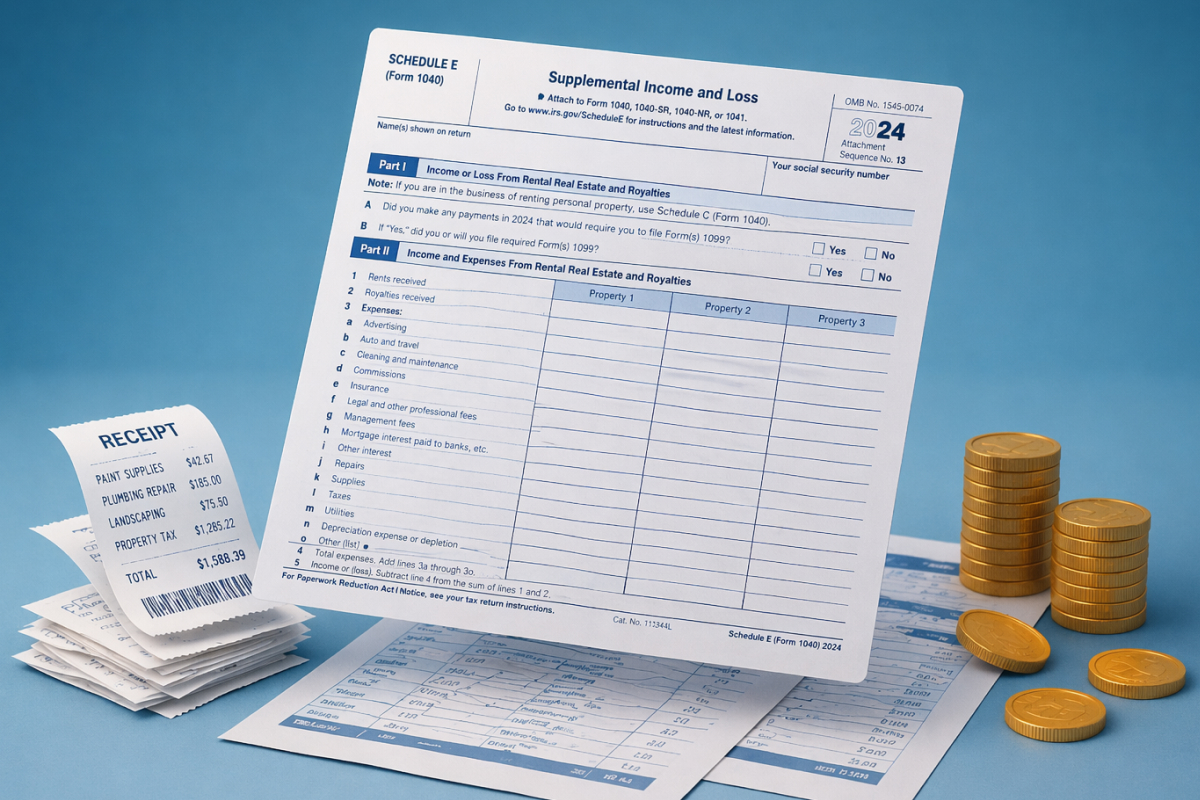
Sole proprietorship / Schedule C: If you own rental property in your own name with no formal entity, your rental income and expenses flow directly onto your personal return via Schedule E. Bookkeeping is simpler here, but liability protection is nonexistent.
Single-member LLC: By default, the IRS treats a single-member LLC as a "disregarded entity" — meaning it's taxed the same as a sole proprietorship (Schedule E on your personal return). But the bookkeeping should still be done at the entity level, with its own books and bank account. If you're ever audited, the IRS will expect to see clean, entity-level records.
Multi-member LLC / partnership: Multi-member LLCs are taxed as partnerships by default. They require a separate Form 1065 partnership return, and income, expenses, and each partner's share flows through to the partners on a Schedule K-1. This means the bookkeeping must be done at the entity level and then K-1s are distributed to the partners at year end. Note that with an LLC, the K-1s can show taxable income without the LLC ever having made cash distributions to the members. In other words, you’ll owe taxes on the profits whether you actually received any of the money or not.
S-Corporation: S-Corps (also known as “making an S election”) are LLCs that elect to be taxed as a Corporation. That means that the entity itself pays taxes directly instead of passing the tax burden to the LLC members. S-Corps require a Form 1120-S return and K-1s for each shareholder. Payroll is required if you're an owner-employee. S-Corps are a populate tax strategy for many types of investors and small businesses, and you should discuss the particulars with your CPA if you want to explore this approach.
C-Corporation: Rare for real estate investors due to double taxation, but sometimes used for specific strategies. Requires a Form 1120 return.
Why this matters for bookkeeping: Each entity needs its own set of books. Commingling records across entities — or between entity and personal accounts — is both a bookkeeping problem and a legal problem. The liability protection that an LLC provides exists only if you treat the LLC as a genuinely separate entity. That means separate books, separate bank accounts, and separate records.
There are lots of things that go into the decisions on how to structure real estate, including for tax planning, estate and trust planning, and risk and liability planning. Keeping accurate records is critical to establishing and maintaining a good investment strategy.
This is the most important operational principle in real estate bookkeeping: every entity gets its own bank account, and nothing personal touches it.
Here's the discipline to build:
One bank account per LLC. Every dollar coming into or going out of each entity runs through that entity's account. No exceptions. If you accidentally pay a property expense from a personal account, document it as an owner contribution and reimburse yourself properly. Don't leave it as an unexplained transaction.
No personal expenses through entity accounts. The IRS has a term for this: commingling. Beyond the tax problems it creates, paying personal expenses from an LLC account can pierce the corporate veil — meaning a court could hold you personally liable for the LLC's obligations. Your liability protection disappears the moment you treat the LLC account as a personal slush fund.
Separate credit cards per entity. If you use credit cards for business expenses, each entity should have its own card. Many banks offer business credit cards tied to an LLC. If you use a personal card for a business expense in a pinch, log it immediately and reimburse the card from the entity account.
Intercompany transactions get documented. If your management company charges a property LLC a management fee, that transaction needs a paper trail: a written management agreement, a monthly invoice or statement, and an actual transfer between bank accounts. Journal entries at year-end don't satisfy the IRS's arm's length requirement.
The investors who dread tax season are almost always investors who do their bookkeeping once a year, in a panic. The investors who sail through tax season are the ones who do a little bookkeeping every month.
Here's what a sustainable monthly bookkeeping cadence looks like for a real estate portfolio:
Weekly (15 minutes):
Monthly (1–2 hours per entity):
Quarterly:
Annually (before sending to CPA):
The goal is that by the time you send your records to your CPA, you already know what everything is. Your CPA should not be manually cleaning your books, they should be confirming the reports and helping you with tax strategy.. You should be handing them clean books with a clear narrative. Not a box of bank statements and a prayer.
A chart of accounts is the backbone of your bookkeeping system: it's the list of categories into which every transaction gets sorted. A generic accounting chart of accounts won't serve a real estate investor well. You need one tailored to how the IRS looks at rental property.
Here's a real estate-appropriate chart of accounts structure, organized around Schedule E line items (since that's ultimately how your income and expenses are reported):
Income Accounts
Expense Accounts — Schedule E Categories
Asset Accounts
Setting up your chart of accounts to mirror Schedule E line items is the single biggest thing you can do to make your CPA's life easier and your tax bill lower, because nothing falls through the cracks.
A good tax strategy needs to be backed up by good documentation. Every deduction you claim needs to be supported by documentation, and that documentation needs to be accessible. A strong audit trail is not just good practice, it's your legal protection if you're ever examined.
Here's what a good audit trail looks like for real estate investors:
Run everything through your bank accounts. Pay all expenses from the entity's business account or business credit card, not in cash, whenever possible. Bank statements are the most defensible records you have. If a payment doesn't show up on a bank statement, it's very hard to prove it happened.
Keep paper copies (or high-quality scans) of everything. Every invoice, receipt, contract, and agreement should be stored for a minimum of three years after the filing date of the return on which it was claimed. For real estate, where depreciation and basis track across decades, the IRS recommends keeping records for as long as you own the property plus seven years after you sell.
Write notes on transactions. When you categorize a transaction that may be unclear, add a brief note explaining what it was and why it's deductible. "Replaced broken dishwasher in Unit 3 — repair, not capital improvement" is far more useful than "Home Depot - $285." When you look back six months later (or when your CPA reviews your books) context matters.
Trust but verify your property managers. Your property manager sends you a monthly statement showing income collected, expenses paid, and your net distribution. That statement should be treated as a starting point, not a final answer. Cross-check it against:
Billing errors, missed lease requirements, and double-charged expenses are common enough that investors who review their management statements carefully routinely find discrepancies. The ones who don't review them just don't know what they're missing.
Depreciation is the single most powerful tax tool available to real estate investors, and it's also the area where DIY bookkeeping most often goes wrong. Understanding how it works and how to track it is essential to building a strong tax and growth strategy.
Using depreciation as a tax strategy should be done with the advice of a qualified CPA that understands your broader goals. Tax filings need to be done carefully and correctly, and mistakes can be expensive and serious. We’re going to explain some high level information below, but we highly recommend consulting a professional before filing your state and federal taxes involving long term assets..
So, what is depreciation? The IRS allows you to deduct the cost of a long term business asset (in our case, real estate) over its useful life. For residential rental property, the IRS assigns a 27.5-year useful life. For commercial property, it's 39 years. This means each year, you get to deduct 1/27.5th (about 3.6%) of the building's value, even if you didn't spend a dime on maintenance and the property actually went up in value.
Critically: you depreciate the building, not the land. Land doesn't wear out, so it's not depreciable. When you purchase a property, you (or your CPA) must allocate the purchase price between land and building. The county assessor's land-to-improvement ratio is commonly used, though other methods exist.
What gets depreciated:
Bonus depreciation and Section 179: Qualifying personal property (appliances, certain equipment) may be eligible for accelerated depreciation — either 100% bonus depreciation in the year placed in service, or expensed immediately under Section 179. Bonus depreciation percentages can be a fantastic way to lower your tax bill, but be sure to confirm the current rate with your CPA.
What to track in your books:
A depreciation schedule is a living document. Every new roof, HVAC system, or unit renovation changes it. If you're not maintaining one, your CPA is building it from scratch every year and potentially missing improvements you made years ago.
Note that typically when you sell an asset, you recapture the depreciation as taxable income. For example, if you purchase a work truck for $75,000 and take advantage of the 100% bonus depreciation, you can deduct the %75,000 from your taxable income. However, if you sell the truck 4 years later for $50,000, you have to pick that $50,000 up in income, or “recapture” the depreciation you wrote off).
One of the most consequential judgment calls in real estate bookkeeping is this: is this cost a repair (deductible in full this year) or a capital improvement (depreciated over time)?
The IRS's tangible property regulations provide the framework. In general:
Repairs and maintenance are immediately deductible. These are costs that keep the property in its current condition — fixing a leaky faucet, replacing a broken window, patching drywall, repainting a unit between tenants.
Capital improvements must be capitalized and depreciated. These are costs that better the property, adapt it to a new use, or restore a major component — a new roof, a kitchen remodel, adding a bathroom, replacing the HVAC system. These are added to your basis and depreciated over 27.5 years (or a shorter life for personal property components).
Why this matters: A $15,000 HVAC replacement deducted in full this year saves you roughly $5,250 in taxes this year (at a 35% marginal rate). Depreciated over 27.5 years, it saves you roughly $191 per year. That's a significant difference in timing — and for investors who actively manage their tax liability, correctly characterizing expenses is worth real money.
The De Minimis Safe Harbor: The IRS allows small businesses to immediately expense items that cost $2,500 or less per item or invoice. Electing this safe harbor, which must be noted in your tax return, allows you to deduct minor items like appliances, tools, and small fixtures without depreciating them. See IRS Rev. Proc. 2015-20 for details.
Effectively, this means you can fully expense pretty much anything you buy that is under $2,500. A good bookkeeping system should help you easily and quickly identify items that are over that $2,500 minimum so they can be reviewed by you and your CPA to determine how the item needs to be treated.
Items investors commonly get wrong:
Tenant-related accounting is where a lot of informal investors lose track of their books and sometimes lose money. A disciplined approach to tracking rent and deposits keeps your records clean and keeps your tenants accountable.
Maintain a current rent roll. A rent roll is a living document listing every unit, the tenant name, lease dates, monthly rent, and payment status. Update it every month. Your rent roll is the source of truth for rental income. If your books show income and the rent roll doesn't, you have a discrepancy to investigate.
Document unpaid expenses and late payments. Things happen. Tenants get behind on payments, miss reimbursement requests, or fail to meet lease requirements. It’s critical to maintain clear paper trails with acknowledgement from the tenant any time there are late or missing payments. However you end up dealing with it, a clear paper trail is critical and can save you significant money.
Track security deposits as a liability. When you receive a security deposit, it does not go into income. It goes into a liability account — "security deposits held" — and should ideally be kept in a separate bank account from operating funds (many states require this by law). When the tenancy ends and you return the deposit, you reduce the liability. If you keep part or all of it for damages or unpaid rent, that portion becomes income at the time it's applied.
Handling security deposits incorrectly is one of the most common bookkeeping errors among DIY investors. It overstates your income in the year received and understates it in the year the deposit is applied.
Document every deposit deduction in writing. If you withhold from a security deposit, your written itemization serves as both a legal document (required by most state landlord-tenant laws) and an accounting record. Keep a copy.
Issue 1099s to contractors. Any contractor, vendor, or service provider paid $600 or more in a calendar year must receive a Form 1099-NEC by January 31 of the following year. This includes your plumber, your landscaper, your handyman. Failing to issue 1099s exposes you to IRS penalties and makes your expense deductions more vulnerable in an audit.
Good bookkeeping isn't just about keeping records. It's about being able to hand those records to your CPA in a form that lets them do their job efficiently. The more organized and complete your package, the less time your CPA spends reconstructing basic information — and CPA time is expensive. A good set of books means that your CPA can work with you on tax strategy and planning instead of doing manual data entry.
Here's what a well-organized CPA handoff looks like:
This is the standard that separates investors who have smooth, efficient tax seasons from those who don't. Your CPA is not your bookkeeper. Their job is to review your records, apply tax strategy, and file correct returns — not to figure out what you spent at Home Depot nine months ago.
Investors of all sizes struggle with bookkeeping. Many use Quickbooks and other full sized accounting platforms, others use the simple systems that are included with property management tools, and some stick with manual excel and bank exports.
Many investors eventually hire a bookkeeper, and for large portfolios, that often makes sense. But there's a real argument for managing your own books — and setting up the right system will help you save real money at tax time. You’ll know your books, your CPA will be well prepared, and you can spend your time focusing on strategy and growth.
You pay yourself $2,000 from the property account. Is that an owner's draw, a management fee, or a reimbursement for the materials you bought out of pocket last month at Home Depot? You know exactly what it was. Without that context, it could land anywhere — and the tax implications of each option are completely different.The closer you are to your own books, the fewer errors — and the fewer dollars misclassified.
Bookkeeping keeps you financially honest. Investors who do their own books tend to know their numbers better. Not only do they catch problems earlier, they also plan better. Are you going to have big tax bill this year? Then you’ll want to go ahead and restripe and seal that parking lot this year instead of next year. A tenant who hasn't paid, a property manager billing for work that wasn't done, a bank fee that shouldn't be there- being on top of your books means you’re on top of your portfolio. That awareness compounds into better decisions.
It's not as hard as it sounds — with the right system. The investors who give up on DIY bookkeeping typically do so because they're using the wrong tool (a generic spreadsheet or a consumer-grade app), or because they let it lapse and then face months of catch-up. With a system designed for real estate and a consistent monthly cadence, most investors can keep clean books in a few hours a month per entity.
The goal isn't to eliminate your CPA, but to work with them more efficiently. A CPA who receives clean, well-organized books can spend their time on tax strategy: cost segregation opportunities, entity restructuring, 1031 exchange planning, retirement account optimization. That's where CPA expertise earns its keep. The more you hand them disorganized records, the more they charge you for data entry — and the less room there is for strategy.
You need something more structured than a basic spreadsheet, especially once you have multiple properties or entities. Generic accounting software like QuickBooks works but isn't purpose-built for real estate and charges per entity. Real estate-specific platforms track income and expenses by property and entity automatically, connect directly to bank accounts, and generate Schedule E-ready reports — which is what you actually need at tax time.
The IRS generally requires you to keep records for at least three years from the filing date of the return. For real estate, keep records related to the property for as long as you own it plus at least seven years after you sell, because basis, depreciation, and capital improvement records all affect the gain calculation at sale.
A repair restores property to working condition and is immediately deductible. A capital improvement betters the property, adds new functionality, or restores a major structural component — and must be depreciated over time. The IRS's tangible property regulations govern this distinction, and your CPA should weigh in on any borderline items.
Yes, if you use a dedicated space in your home exclusively and regularly for managing your real estate business. The deduction is calculated based on the percentage of your home's square footage used for business. See IRS Publication 587 for the rules and Form 8829 for reporting.
It depends on how wrong and for how long. If you've been miscategorizing transactions or missing deductions, your CPA may be able to file amended returns (Form 1040-X) to correct prior years. If there are serious errors — unreported income, incorrectly claimed deductions — it's best to get ahead of it proactively with your CPA rather than wait for the IRS to find it. In most cases, honest errors corrected promptly are treated much more leniently than errors left to accumulate.
Generally, yes — if you pay your property management company $600 or more during the calendar year, you should issue a Form 1099-NEC. There is an exception for payments made to corporations (including S-Corps and C-Corps), but partnerships and sole proprietors do need to receive 1099s. When in doubt, issue the 1099.
The information in this guide is for educational purposes only and does not constitute tax or legal advice. Real estate accounting rules are complex and fact-specific. Always consult a qualified CPA or tax advisor who specializes in real estate before making decisions about your bookkeeping or tax strategy.
Our real estate proforma is a forward-looking financial model (in Excel) built to help investors understand a property’s projected performance so you can make informed decisions with confidence.

Real estate portfolio management &
accounting software

Your data secured by Plaid.
Copyright 2026 Kestrel, LLC


.svg)